

Most cataracts form so gradually that people rarely notice the earliest changes. Vision stays sharp enough to read, drive, and go about daily life, and the clouding advances, unnoticed, in the background until one day the difference becomes obvious.
However, knowing what happens at each stage helps you understand your own eyes and recognize when it makes sense to act. Keep reading to learn more about how cataracts progress over time.
What Are Cataracts?
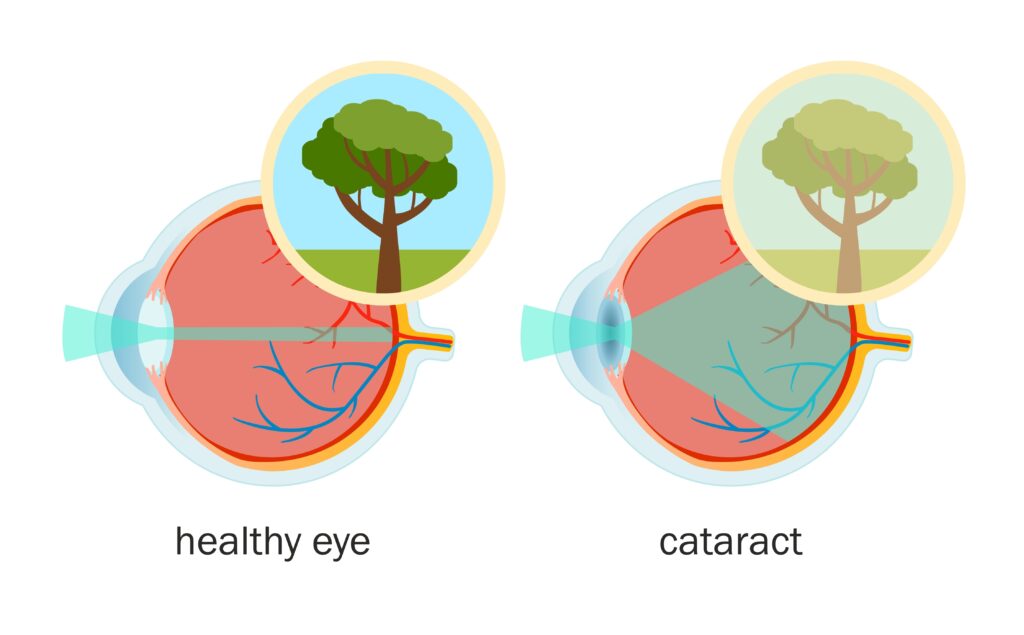
The natural lens of your eye plays a key role in clear vision by focusing light onto the retina at the back of the eye. In a healthy eye, the lens is clear, and light passes through cleanly to produce a sharp image.
With age, the lens becomes thicker, less flexible, and less transparent. The proteins and fibers that make up the lens begin to break down and clump together, and those clumps are what create the cloudiness of a cataract.
Once the lens starts to cloud, it scatters and blocks light instead of focusing it, so a clearly defined image no longer reaches the retina. The result is vision that looks hazy, dim, or fogged, as though you are looking through a frosty window.
The Early Stage: When You May Not Notice Anything
In the beginning, a cataract affects only a small portion of the lens. Because so little of the lens is involved, the effect on your sight is minor, and many people have no idea a cataract has started to form. An eye doctor may spot it during a routine exam long before you notice any change yourself.
At this stage, simple adjustments usually keep vision comfortable. Brighter lighting for reading, an anti-glare lamp, or an updated glasses prescription can offset the small amount of clouding. Surgery is not on the table yet, and it does not need to be. The cataract is present, but it is not interfering with the things you want to do.
The Progressive Stage: Symptoms Become Harder to Ignore
As the cataract develops, the clouding spreads across more of the lens, and that changes how light passes through the eye. Symptoms that were once too subtle to register start to affect everyday activities. This is the stage when most people first suspect something is wrong.
Common signs include blurred or dim vision, needing stronger light when reading, and trouble seeing in bright sunlight. Night driving often becomes uncomfortable, with halos or starbursts appearing around headlights and streetlights.
Colors may look faded or take on a yellow tint, and some people notice double vision in a single eye. A telltale clue is needing frequent changes to your eyeglass or contact lens prescription, since the eye keeps shifting as the lens changes.
The Advanced Stage: When Cataracts Interfere With Daily Life

Left alone, a cataract continues to mature until the clouding covers much of the lens. At this point, the symptoms are no longer occasional annoyances. Reading small print, recognizing a friend’s face across a room, and driving safely at night all become genuinely difficult. In an advanced cortical cataract, the lens can appear almost completely white.
An important point often surprises people: once a cataract has formed, it cannot be reversed. No eye drop, medication, or lifestyle change clears an existing cataract.
A healthy diet and sun protection may slow the development of cataracts, but they do nothing to dissolve one that already exists. Cataracts keep worsening over time, and untreated, they can eventually erode your independence and quality of life.
What Influences How Fast Cataracts Develop?
Cataracts do not develop at the same speed for everyone. Some people have mild clouding for years, while others notice changes in just a few months. Many factors can affect how quickly cataracts progress.
Age is the main reason cataracts develop, but your health and lifestyle also play a role. Diabetes can speed up changes in the lens, and using steroid medicines for a long time can also contribute.
Spending a lot of time in the sun without eye protection, smoking, drinking heavily, being overweight, or having had an eye injury or surgery can all increase your risk of cataracts and affect how fast they develop. Having family members with cataracts also raises your risk.
When Is It Time to Consider Cataract Surgery?

Surgery is the only effective treatment for cataracts, and modern cataract surgery ranks among the safest and most reliable procedures in medicine. That said, there is no universal moment when everyone must have it.
The best time for surgery depends on how much the cataract is affecting your daily life. If new glasses or better lighting are no longer enough, and things like driving, reading, or working become difficult, it may be time to consider treatment.
At BVA Advanced Eye Care, our experienced surgeons offer advanced treatments that are much more effective than older cataract removal methods. Laser cataract surgery uses a femtosecond laser to make precise incisions and gently break up the clouded lens, which tends to mean less trauma to the eye and a quicker recovery.
ORA-guided surgery adds real-time wavefront analysis during the procedure, measuring how light focuses through your eye so the surgeon can select and position the replacement lens with a high degree of accuracy. Premium intraocular lenses, including multifocal and extended-depth options, can restore clear vision at multiple distances and reduce your dependence on glasses afterward.
During your consultation, your cataract surgeon will talk with you about which treatment and lens are best for your eyes, your lifestyle, and your vision needs. Knowing how far your cataract has progressed helps you make a confident decision, instead of waiting until vision loss makes the choice for you.
Wondering whether your cataracts have progressed to the point where treatment makes sense? Schedule an appointment at BVA Advanced Eye Care in Oklahoma City, OK, today. Our team is here to help you every step of the way.